
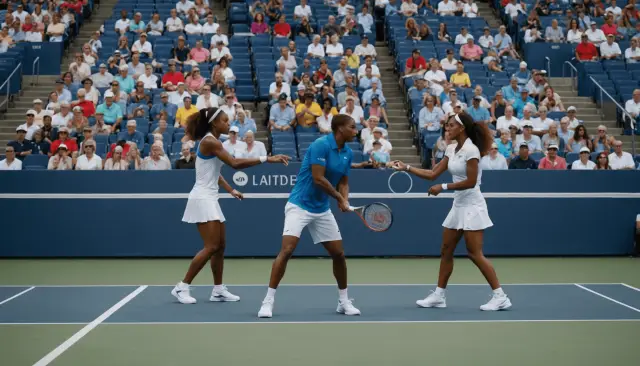

The opening week of the US Open has arrived, and the day's marquee attraction isn't a singles contest at all: it's the start of mixed doubles, featuring a pairing few saw coming. Serena Williams will step onto the court alongside Carlos Alcaraz, a generational meeting that pairs one of the sport's most decorated names with its current standard-bearer. The same day also brings the top-seeded mixed doubles pairing, Aryna Sabalenka and Novak Djokovic, while qualifying rounds for the men's and women's singles draws continue in parallel.
Founded in 1881, the US Open trails only Wimbledon as the oldest continuing Grand Slam event, and like the Australian Open, it's played on hard courts rather than grass or clay - a surface that tends to reward flatter, faster shot-making. This year's edition runs from August 23 through September 13 at the USTA Billie Jean King National Tennis Center in Queens, New York, with qualifying rounds, mixed doubles, and later the singles, doubles, junior, and wheelchair events staggered across the three-week calendar. For international viewers hoping to follow the action without running into regional blackout restrictions, a reliable option such as a vpn for turkey can make a meaningful difference in accessing coverage that might otherwise be geo-limited. vpn for turkey
Getting Access Without Cable
ESPN holds exclusive broadcast rights to the US Open, just as it does for Wimbledon, which means cord-cutters need a streaming path that includes Disney's sports programming. Several options now serve that purpose. DirecTV's base package starts at $59.99 for the first month and includes ESPN Unlimited, while ESPN's own standalone streaming service begins at $29.99 monthly. Fubo offers ESPN through its Sports plan at $55.99 per month, Sling's Essentials tier includes the channel for $19.99 monthly (with a $4.99 Day Pass for single-day viewing), and YouTube TV bundles it into a $64.99 Sports Plan.
Why Location Matters for Streaming
Broadcast rights are sold on a territory-by-territory basis, which is why a service airing the US Open in one country may block access elsewhere. A virtual private network addresses this by routing a device's internet traffic through a server in another location, making it appear as though the connection originates there. This doesn't alter the content itself - it simply changes what the streaming platform believes about the viewer's location. Providers with a wide, well-maintained server network, such as ExpressVPN, tend to handle this more reliably than free or lesser-known alternatives, which often struggle with speed, stability, or being blocked outright by streaming platforms.
To watch through this method: subscribe to a streaming-capable VPN, install the app on the intended device, connect to a server in the target country, and then open the relevant streaming service. Whichever way you watch, enabling motion smoothing on a television can noticeably improve the viewing experience - just remember to switch it off afterward, since it tends to distort the look of films and scripted television.
A Deep Field Across the Draws
This year's event includes seventeen former Grand Slam singles champions, ten of them past US Open winners. The men's draw is led by Jannik Sinner, Alexander Zverev, Carlos Alcaraz, and Novak Djokovic, while Aryna Sabalenka, Elena Rybakina, and American Jessica Pegula sit atop the women's rankings. The mixed doubles slate is similarly stacked, pairing Iga Swiatek with Casper Ruud, Jessica Pegula with Jack Draper, and Taylor Townsend with Alexander Zverev, alongside Venus Williams and Alexander Bublik. The United States fields 28 competitors in the main draw, more than any other nation, including Coco Gauff, Amanda Anisimova, Ben Shelton, and Taylor Fritz. Away from the official competition, five-time champion Roger Federer will appear in an August 25 exhibition with Andy Roddick, Andre Agassi, and John McEnroe, while a group of emerging talents - including João Fonseca, Alexandra Eala, and Learner Tien - takes the court on August 27.
