
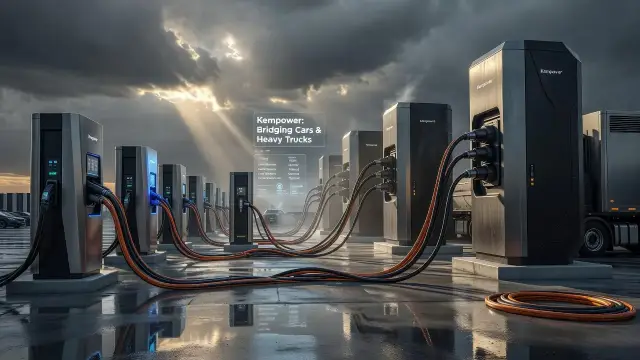
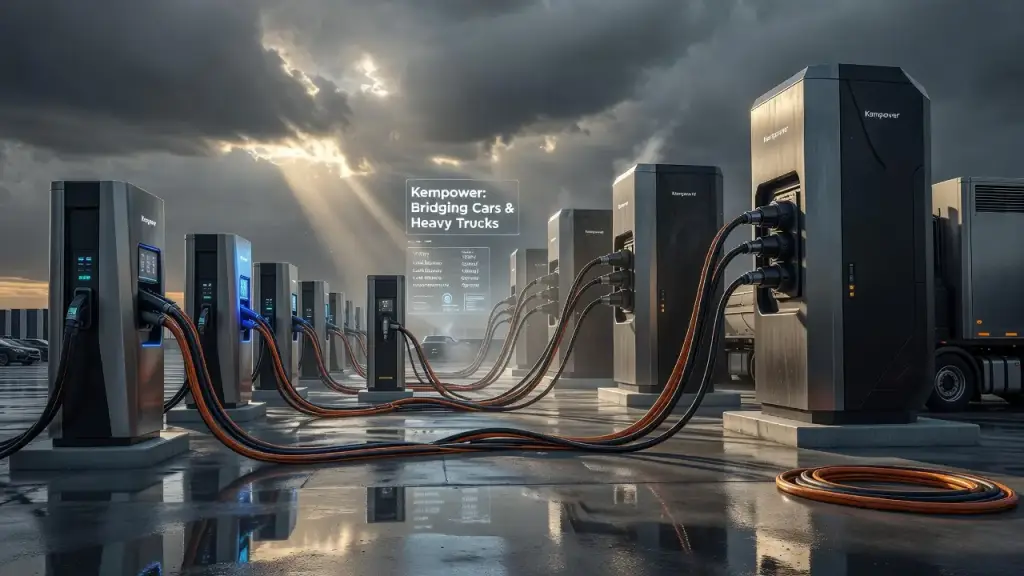
Kempower has introduced a charging dispenser designed to solve one of the most expensive problems in electric vehicle infrastructure: building separate stations for cars and trucks. The new Mega Satellite Flex supports both the established CCS standard, at up to 560 kW, and the emerging Megawatt Charging System, at up to 1.2 MW, making it the company's first unit capable of serving either standard from a single point of installation.
The announcement came this week at ACT Expo, where Kempower unveiled the charger during its Unplug & Recharge event for customers and partners. For fleet operators and charging site developers watching the slow, capital-intensive rollout of truck charging infrastructure, the details are worth reading, because the design directly addresses a financial risk that has held back investment: paying to build once, only to rebuild later as vehicle technology and charging standards shift. the details are worth reading
Why Two Standards Matter Right Now
CCS has been the dominant charging standard for passenger EVs for years, and most existing infrastructure is built around it. Heavy-duty electric trucks, however, need far more power to make sense economically, since long routes and tight delivery schedules leave little room for lengthy charging stops. That need has driven development of the Megawatt Charging System, a newer standard designed specifically for commercial vehicles that can accept charging rates far beyond what passenger cars require. The two standards are expected to coexist for years, since truck fleets will electrify gradually while passenger vehicles continue to rely on CCS and increasingly on higher-voltage architectures.
The Mega Satellite Flex is built around that overlap. It handles up to 700 amps on CCS and up to 1,500 amps on MCS, with cable lengths of 5 meters for CCS and 2.7 meters for MCS. It also supports 800-volt EVs, a battery architecture increasingly common in newer passenger and commercial vehicles because it allows faster charging without the thermal and efficiency penalties associated with older 400-volt systems.
The Business Case for a Shared Site
Charging infrastructure is expensive to install and slow to earn back its cost, particularly at sites built exclusively for trucks, which see less consistent traffic than passenger charging hubs. By allowing one dispenser to serve both vehicle types, Kempower is betting that site owners will reach profitable utilization sooner, since the same hardware can serve a passenger car in the morning and a delivery truck in the afternoon. That flexibility also reduces the risk of stranded investment if truck adoption in a given region moves slower than expected, since the same equipment still generates revenue from car charging in the meantime.
The unit is also compatible with Kempower's existing distributed charging architecture, meaning operators who already use the company's systems can add Mega Satellite Flex units without reconfiguring their entire site. An optional payment terminal is available as well, a detail that matters for public charging locations that need to serve occasional users rather than only fleet accounts with existing billing arrangements.
What Comes Next
Kempower says the Mega Satellite Flex will go on sale in North America and Europe in July 2026, giving the company and its customers more than a year to prepare deployment plans. That timeline lines up with broader industry expectations that MCS-capable trucks will begin appearing in meaningful numbers over the next several years, though the pace will depend on truck manufacturers, regulatory support, and the buildout of charging corridors along major freight routes. A charger that serves both standards does not solve every obstacle to electrifying heavy transport, but it removes one of the more costly ones: the need to guess correctly, years in advance, which vehicles will actually show up to charge.
